

Complete Guide For Safely Walking a Dog at Night

Safely walking a dog at night requires a combination of reflective or light-up accessories for both you and your dog, along with sticking to familiar paths, and ensuring your pup knows basic verbal commands like “leave it” and “come.”
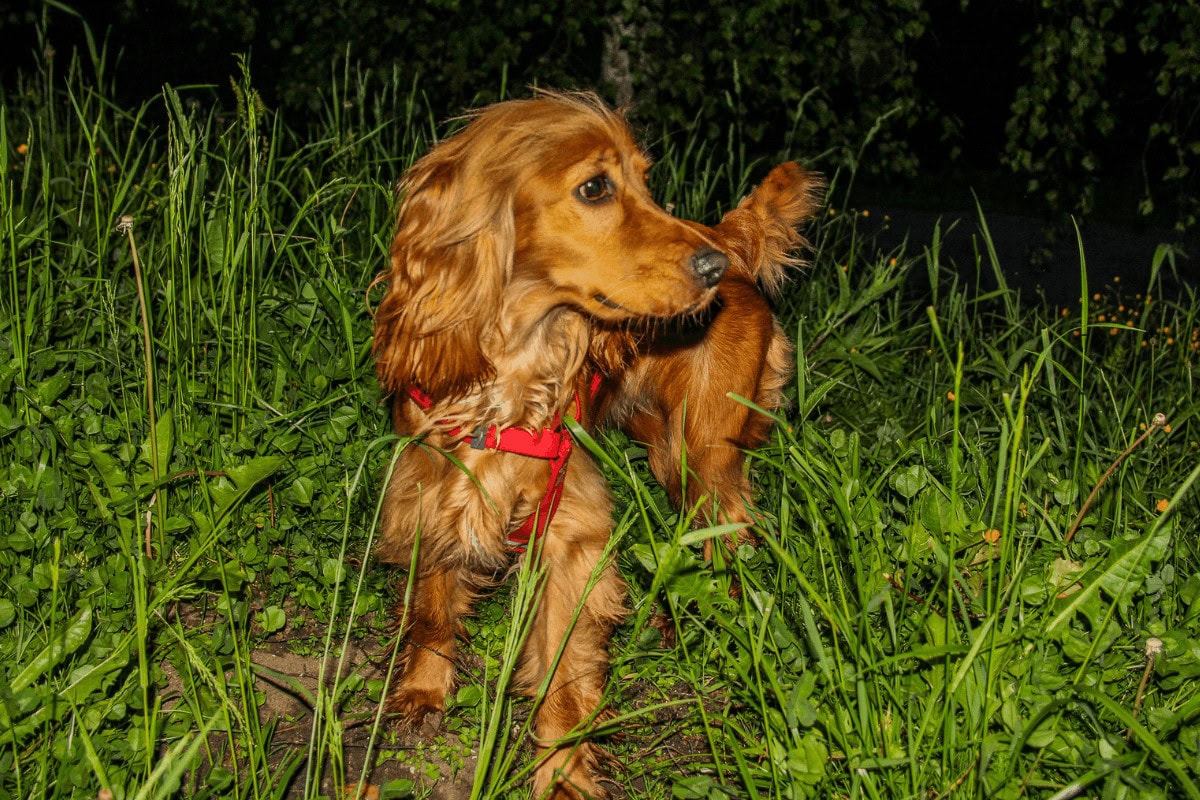
My Cocker Spaniel, Sir Alvin, and I were on a night walk a few months ago when it got dark at 5 p.m. Suddenly, a bicyclist sped past us on the sidewalk, and we were nearly knocked over. The guy never alerted us that he was coming, so thank goodness for my fast reflexes to quickly pull Sir Alvin closer to me. It was in that moment that I knew we had to be more visible for walking at night.
I’ve been in veterinary emergency rooms with my dogs late at night, and inevitably, someone comes in with a dog that’s been hit by a car. It isn’t pleasant, and it’s often preventable. Some studies estimate that around 75% of pedestrian fatalities occur in low-light conditions, often because drivers don’t see people (and pets) quickly enough.
Fortunately, with the right gear, route planning, and training, you can turn evening walks into safe, enjoyable routines for both you and your dog. Here’s your complete guide to safely walking a dog at night, from first-hand experience and what other experts have to say.
As a bonus, I am also giving away some products to keep your dog safe and visible at night, so be sure to enter the giveaway below.
Some of the links in this article are affiliate links. As an Amazon Associate, I earn from qualifying purchases. I am also an Etsy and Chewy affiliate.
Why Walking a Dog at Night Can Be Risky
Whether you’re squeezing in a quick walk after work, accommodating a puppy’s unpredictable schedule, or simply prefer cooler temperatures, nighttime walks aren’t only seasonal; they’re a year-round reality for most pet parents. Minimizing risks to you and your dog is essential to help you stay safe while enjoying your walks. Here’s what to be aware of when out at night with your dog:
Traffic and Vehicle Hazards
Reduced visibility increases traffic risk. Drivers may not see a dog stepping off the curb, especially in poorly lit residential areas. Vehicles backing out, cyclists approaching quietly, and distracted drivers in parking lots add unpredictability. Some dogs may lunge toward or away from headlights, increasing the chance of a sudden pull into the road.
Wildlife Encounters
Many animals are most active after dark. Skunks, raccoons, opossums, coyotes, and deer can appear unexpectedly. Dogs often detect wildlife before we do and may react suddenly. Darkness also makes it harder to spot porcupines, snakes, or other animals until your dog is too close.
Environmental Hazards
Uneven pavement, roots, curbs, and debris are harder to see at night. Dogs may step on broken glass or sharp objects before you notice them. Ice, wet leaves, or slick surfaces increase fall risk. Toxic substances on the ground can also go unnoticed in low light.
Other Dogs and People
Off-leash or reactive dogs may appear suddenly from dark areas. It’s harder to read canine body language in low light, reducing your ability to anticipate tension. You may also unintentionally startle pedestrians who don’t see you approaching. Or, as in my case, a bicyclist may appear out of nowhere without warning.
Visibility and Control Challenges
Low light affects communication and control. You may briefly lose sight of your dog if they move ahead or to the side. It’s harder to see what your dog is sniffing or picking up. Subtle stress signals and body cues can be missed in darkness.
Personal Safety and Security Concerns
Night walks mean fewer bystanders and less immediate help if something goes wrong. Poor lighting can increase anxiety for both dog and handler. In unfamiliar areas, it’s easier to become disoriented or miss escape points in fencing.
Hunting Season
In many suburban and rural areas, hunting season adds an additional layer of risk to nighttime and early-morning walks. Reduced visibility makes it harder for hunters to distinguish movement at a distance.
Dogs that roam ahead or move off-trail may be mistaken for wildlife, especially if they blend into the surroundings. During hunting season, stick to well-marked trails, avoid wooded areas at dawn and dusk, and use highly visible gear (for you and your dog) to increase contrast against natural terrain.
How to Make Your Dog Visible at Night
After our near-accident with a bicyclist while walking my dog at night, I contacted certified professional dog trainer Robin Bennett for her suggestions. With her 20+ years in the pet care industry, I knew she’d have ideas for nighttime visibility.
“One of the simplest ways to improve safety when walking a dog at night is to increase visibility from multiple angles,” Bennett stated. “Reflective stitching helps drivers, cyclists, and pedestrians see movement sooner, especially when headlights or streetlights reflect off the material.”
Bennett explained it’s important to understand how reflective gear works. It does not glow in complete darkness. It becomes highly visible when an external light source, such as car headlights, bike lights, or a flashlight, shines on it.
Not all reflective gear for dogs is created equally. She told me about the Blue-9 Reflective Balance Collection, which includes harnesses, leashes, collars, and accessories featuring professional-grade 3M Scotchlite reflective stitching woven directly into the straps. When light hits the reflective material, it bounces back toward the source, using the same technology used in runner and road worker safety gear.
So I decided to invest in three Blue-9 Reflective products: The Reflective Balance Harness, the Reflective 6’ leash, and the Reflective Tab Leash.
In real-world use, using the Blue-9 Reflective gear at night means:
- Headlights make the reflective stitching light up quickly
- Streetlights catch the reflective thread from multiple angles
- My dog is more easily seen than with dark nylon alone
No matter the season, weather, or conditions, Bennett told me that Blue-9’s reflective dog gear is designed for year-round use.
Bonus: Rechargeable LED Safety Necklace for Dogs
I did the homework and trials for you with clip-on lights and LED safety necklaces for dogs. For pet parents who prefer an additional layer of nighttime protection, the Nite Ize Rechargeable LED Safety Necklace is a time-tested favorite.
Prior to discovering the Blue-9 line of reflective gear, Sir Alvin used the Nite Ize weather-resistant, rechargeable collar. It doesn’t replace the visibility boost that Blue-9’s reflective gear gives you, but it adds an active light layer that enhances safety, especially in complete darkness or very low light. The only downside is that it does not include the necessary USB-C charging cable, but most people have one or more around the house.

How Blue-9 Reflective Balance Products Work for Nighttime Visibility
Blue-9 Reflective Balance Harness
Sir Alvin uses this harness for all his nighttime walks, and I use it during our daytime walks as well. I appreciate that it combines comfort, control, and enhanced visibility in one product. The reflective stitching runs along the adjustable straps, making your dog easier to see from multiple angles once light hits the material.
Because it rests across the chest and shoulders, the reflective surface is positioned to catch headlights, street lamps, and other light sources during early-morning or evening walks.
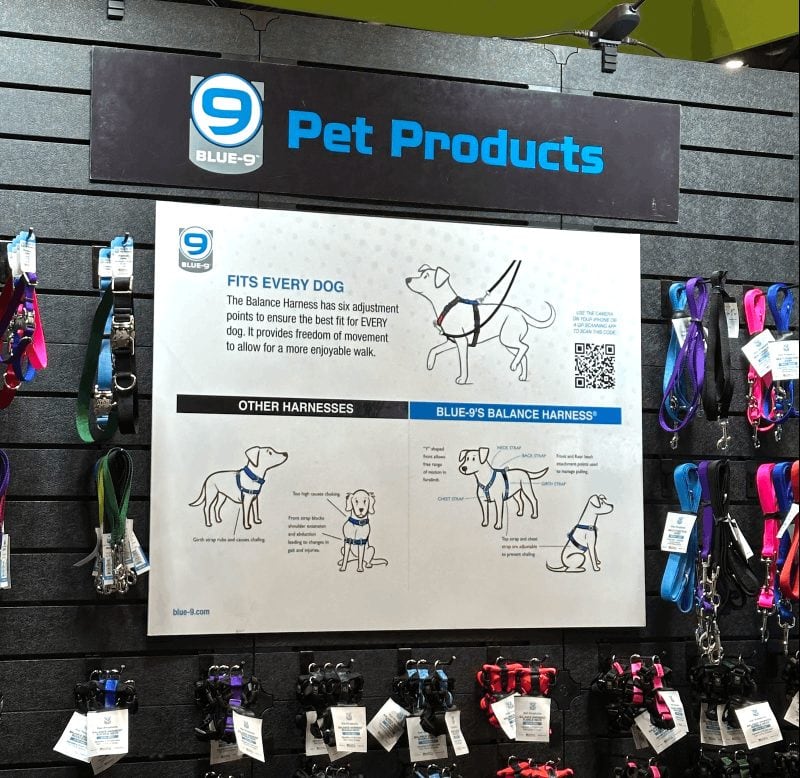
I confess that it’s been a struggle to find a harness I like, that is comfortable for Sir Alvin, and that keeps him visible at night. Fortunately, after trying dozens of harnesses over the years, we settled on the Blue-9 Reflective Balance Harness for its:
- Multiple adjustment points so dogs get a secure, customized fit
- Dual leash attachment points for improved control while walking your pooch
- A design that reduces pressure on the neck and throat, as I never walk my dog on a collar. We use the collar for decorative purposes and for his tags.
These features help keep dogs comfortable and visible, especially in transitional light conditions or after dark.
Pro Tip: A neighbor of mine is a police officer. He told us that many car accidents occur at dusk or when people are hurrying home from work, which is often a darker time of day. The Blue-9 reflective features help keep dogs comfortable and visible, especially in transitional light conditions or after dark.
USE CODE FIDOSE20 TO SAVE 20 PERCENT OFF AT BLUE-9.COM OFF MOST PRODUCTS
Blue-9 Reflective Multi-Function Leash
I appreciate this leash because it offers six options in one reflective leash. Featuring two heavy-duty clips with versatile connection points, it adapts to:
- Full 6-Foot Length: Ideal for relaxed neighborhood walks, basic obedience work, and giving your dog room to explore safely.
- Shortened 3.5-Foot Mode: Maintains tight control near traffic, in crowded spaces, during focused training, or whenever proximity matters. Many pet parents prefer this shortened mode at night for short walks.
- Hands-Free Configuration: Wear it cross-body for runs, hikes, or anytime you need your hands available for bags, phones, kids, etc.
- Dual-Dog Setup: Manage two dogs with a single leash by attaching both clips to separate collars. You read that right: dual-dog setup.
- Instant Traffic Grip: Built-in short handle lets you reel your dog in fast when cars approach, or situations escalate
- Temporary Anchor: Clip your dog to a bench, pole, or tree while you grab coffee, tie your shoe, or load the car. Have eyes in the back of your head, please, because we never recommend clipping your dog up unattended.
USE CODE FIDOSE20 TO SAVE 20 PERCENT OFF AT BLUE-9.COM ON MOST PRODUCTS
Blue-9 Reflective Tab Leash
This 9-inch training tool, like all Blue-9 products, is designed by professional dog trainers and ideal for transitioning to off-leash work, advanced obedience, and everyday control.
So perhaps you are at a park and training your dog for off-leash, or you need something on your dog for immediate control, the Reflective Tab Leash:
- 9-Inch Quick-Grab Length: Long enough to catch easily in motion, short enough to avoid dragging or snagging on brush and obstacles.
- 3M Scotchlite Reflective Stitching: High-visibility threading that bounces back light from headlights and streetlamps during early morning or evening outings.
- Soft-Touch Nylon Webbing: Durable yet gentle material that stays comfortable against your dog’s neck without adding bulk or weight.
- 5/8-Inch Width: Balanced sizing that’s easy to grip and works well across small to medium-large breeds.
- Heavy-Duty Clip: Reinforced hardware built to handle sudden pulls, quick corrections, and energetic dogs.
- Machine Washable: Holds up to regular cleaning, such as throwing it in with your laundry after muddy hikes or rainy walks. I’ve done this repeatedly.
- Ultra-Lightweight Design: Minimal weight won’t disrupt your dog’s movement, balance, or training focus.
USE CODE FIDOSE20 TO SAVE 20 PERCENT OFF AT BLUE-9.COM ON MOST PRODUCTS
How to Stay Visible as the Pet Parent For Night Walks
With your dog being safe and visible at night, it’s important for you, the pet parent, to be seen as well. Drivers typically notice human movement first, especially at chest and eye level. If you are hard to see, your dog may not be seen either.
What should I wear when walking my dog at night?
Wear reflective or high-visibility clothing, such as a vest or jacket, and use a headlamp or LED armband for added brightness. Reflective materials improve visibility when headlights hit them, while active lights help drivers see you even in very dark conditions.
I believe in having choices, so whether you prefer a flashlight, a clip-on light, reflective clothing, or something else, here are a few of my favorite pet parent must-haves for nighttime walks. I own and use them in rotation, so I can attest to their efficacy and longevity:
Black & Decker Carabiner Multi-Tool 500 Lumens Flashlight
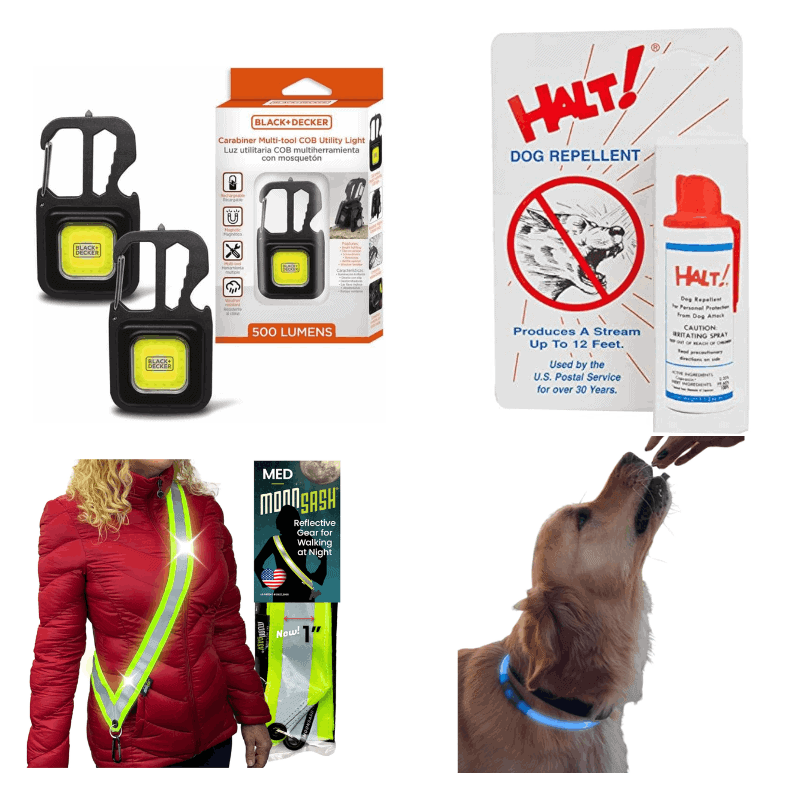
Available in a two-pack, I kept one and gave the other to my spouse. I clip this to my dog-walking bag, and when I need to shine a light to pick up poop or be seen, it is affordably priced and easy to use, with seven light modes. It’s rechargeable and retains its charge for an extended period. It includes its own charging cable.
Moonsash Reflective Sash for Walking At Night
This pet parent item is a game-changer. I learned about it from a jogging friend who wears it at night. This reflective sash works differently from reflective strips on pants or shoes. By placing high-visibility material across the torso, it aligns with a driver’s natural windshield scanning pattern. I like that I can just toss it on and go. It doesn’t require charging or batteries, is available in multiple sizes, and is under $20.
Halt Repellant Spray
Walking at night also means being safe. I’ve been nearly attacked by dogs off-leash, so I know a thing or two about being ready for anything. A product like HALT! Dog Repellent can provide a non-lethal option to create space between you and a loose dog, deter an aggressive or unpredictable dog safely, and help you feel more secure when walking in less populated or poorly lit areas. I learned about this product from our mail carrier.
Choosing the Safest Routes to Walk at Night
What is the safest place to walk a dog at night?
Stick to wall-lit residential streets with sidewalks and minimal traffic, if possible, for walking your dog at night. These areas become familiar, likely offer good visibility, and are close to other homes or residents for help if needed.
When I walk with Sir Alvin, we stick to familiar routes. I’m all for changing up your dog’s walks, but at night, for safety reasons, it’s best to stick with what you know and where you know. Walking your dog after dark requires more intentional route planning. Prioritize residential streets over busy roads, as they typically have slower traffic and better lighting. Stick to paved sidewalks rather than gravel paths, which can hide hazards. Avoid blind curves where drivers can’t see you early, and cross at well-lit intersections instead of mid-block.
Use extra caution in parking lots, where vehicles may back out unexpectedly, and visibility is limited. Even in familiar neighborhoods, stay alert to changing lighting conditions and new obstacles. Choosing consistent, well-lit routes and remaining attentive significantly reduces risk for both you and your dog.
For dog parents who live in rural areas or neighborhoods without sidewalks or consistent lighting, route planning is a bit different. Stick to roads with wide shoulders whenever possible and avoid high-speed traffic areas. Walking earlier in the evening before it’s fully dark may be safer than late-night outings. In very dark areas, reflective visibility gear and active lighting become even more important, and keeping your dog on a shorter leash helps maintain control when visibility is limited.

Training for Predictability in Low Light
It’s always important to have reliable leash skills, but they become critical in low light. Loose leash control prevents sudden pulling or weaving that could pull you toward traffic or unseen obstacles. An emergency stop cue that halts your dog mid-stride provides an added layer of safety if a car appears suddenly or you spot a hazard ahead.
Regular check-ins during walks keep your dog mentally connected to you rather than fixated on shadows, distant sounds, or movement. Preventing darting toward squirrels, cats, or unexpected triggers is especially important at night when your reaction time is reduced.
Shadow desensitization is another overlooked but valuable skill for nighttime preparedness. Streetlights and headlights create elongated shapes and sudden moving shadows that can cause some dogs to spook, freeze, or lunge.
Gradually exposing your dog to these visual distortions, starting in well-lit areas at dusk and progressing to darker environments, builds confidence and predictability. With consistent training, your dog will be a steady, responsive partner in low light rather than a liability when visibility is limited. Never scold or become loud with your dog during training. The goal is to be a kind partner and the kind of person your dog knows you are.
Bonus Pro Tip: I train my dog regularly and enjoy these indoor exercises and games for mental stimulation and training. Here’s how to train your dog indoors to strengthen the human-animal bond and keep your dog happy and safe.
Seasonal Night Walk Safety Tips
Winter
Winter brings earlier darkness, icy surfaces, and increased use of road salt and de-icing chemicals. Ice patches may be invisible under streetlights, and wet pavement can refreeze quickly.
Shorter daylight hours mean more walks happen in low light, making reflective and active lighting even more important. Consider protective paw care if salt is heavily used in your area, and choose well-maintained sidewalks whenever possible. Slower, shorter strides and steady leash control help reduce slips for both you and your dog.
Summer
In summer, pavement retains heat long after sunset, especially in urban and suburban areas. Even if the air feels cooler at night, asphalt may still be warm enough to irritate paw pads. Early dawn walks can be safer than late evenings in high-traffic areas, but reduced visibility still requires reflective and active lighting.
Summer also brings increased foot traffic, cyclists, and outdoor activity, so maintaining predictable leash control and awareness of your surroundings is essential.
Fall
Fall introduces earlier sunsets and seasonal distractions. Falling leaves can hide uneven pavement or slick surfaces, increasing trip risk. In many suburban and rural areas, hunting season adds another layer of consideration. If you walk near wooded areas or open land, wear high-visibility gear and avoid heavily wooded trails at dawn or dusk.
Reflective and bright colors increase contrast against natural terrain, helping you and your dog stand out.
Spring
Spring often brings increased wildlife activity as animals emerge from winter. Encounters with skunks, raccoons, deer, or other animals may be more likely during nighttime walks. Melting snow and rain can create uneven or muddy terrain, and new growth may obscure holes or debris along paths.
Maintaining loose leash control, reinforcing check-ins, and choosing well-lit, familiar routes help reduce surprises during this transitional season.
Watch the video below to see how to fit your dog for the Blue-9 Reflective Harness:
Frequently Asked Questions
Yes, it can be without proper preparation. Follow our advice for visibility, safety, and familiar paths to keep you and your dog safe at night while out on a walk.
Blue-9 reflective harnesses and leashes use reflective stitching that lights up when headlights or flashlights hit them. That makes your dog more visible to drivers in low light.
Dogs do see better than people in low light, but not in total darkness. Dogs have more rod cells in their retinas than humans. Rods are the cells responsible for detecting movement and seeing in dim light. That’s why dogs tend to move around more confidently at dawn and dusk.
For nighttime safety, bright, high-visibility colors such as neon yellow, neon green, and bright orange are easiest to see in low light and at dusk. However, at true nighttime, reflective materials matter more than color. Reflective silver or white strips light up when headlights hit them, making you and your dog far more visible to drivers.
For best results, choose gear that combines high-visibility color with reflective stitching or panels. In very dark areas, adding an LED light or headlamp provides even greater visibility.
Final Thoughts on Walking With Your Dog at Night
Car headlights, bike lights, and headgear lights will make the stitching on the Blue-9 Reflective products shine bright. It’s always a good idea to ensure you, the pet parent, are visible. If you walk in very dark areas, you can combine reflective gear with something that emits light, like a safety light or blinking tag (which you or your dog wear) to make them even easier to see from all angles
How do you keep yourself and your dog safe at night while out on walks? Let us know in the comments below. Here’s to staying safe!

GIVEAWAY CLOSED: Enter to Win Blue-9 Reflective Gear
If you can’t wait to see if you won, be sure to use code FIDOSE20 at Blue9.com for 20 percent off most items.
Head to the comments section and tell me the name of the dog that would benefit from a Blue-9 Reflective Harness. If your name is selected at random, you could be one of the two winners who each will receive the Blue-9 Reflective Harness in the size and color of your choice!
Read our rules and terms here. Must be 18 and live in the USA to enter. Winners will be drawn from all entries on or about February 27, 2026. Winners have 48 hours to reply to email indicating they won.
The two winners selected at random are:
- Heather Johnson
- Sandy Weinstein
Congrats to all and thanks to everyone for entering!
Carol;
When I walk our American Cocker Spaniel, Jolly, at night I ALWAYS carry a flashlight. When we are crossing a main street I pick her up and walk across the street carrying her, with the flashlight on. Near where we live, there is a blinking street signal that indicates a walker crossing the street. Many times drivers ignore the signal and just drive through but most people do stop, but I am always very aware, and careful, when when crossing a street with Jolly.
My beautiful pups name that would love this is Kyah, she turned 11 mos old yesterday and is a work in progress. She is a precious Vizsla and loves her walks. We live in the country so it is very dark out early on and no street lights so this would be perfect. Thank you for the chance to win.
Cocoa Puff could use a reflective harness, She has a Kong harness that has a little light, but the reflective stitching sounds great. The handy Black and Decker lights are something I’m going to look for.
Chloe would benefit from a reflective harness since she likes to walk at night since it’s cooler and people doesn’t pay attention to people and dogs walking.
Loki – God of Mischief
Stella would use this. We go walking early morning and need it then.
Boomer would be the one to use the reflective harness. Thanks for considering us..
I have several dogs to walk and sometime we gave do the walks in the evening. Rose our medical foster likes to lead and she would definitely benefit bring reflective.
We always enjoy your emails and find them very informative…
Remi would be wearing the harness (after a brief struggle to get it on him). Lol. Loves to walk. Does NOT love to wear a harness.
My dog Bandit has to go for walks. He needs exercise so he could lose some weight.
I would use it on Balsam. I’ve noticed that as some of his hearing and close-up vision are starting to decrease he seems to depend more and more on his nose, dragging me as he follows an interesting scent. I don’t want to damage his throat if he yanks me in a direction I’m not anticipating.
My dog Teddie is a therapy dog. She has a harness when she is working but a different one when we are walking but lately, she is trying to an escape artist, and she pulls out of it. We would love a new harness. Teddie says ARRROOOWWW
Woodrow
Agatha Fiona could use a reflective harness. She’s a puppy mill breeder release adopted from a shelter. She spent nine years confined, having puppies,making money for someone. All the walking supplies, the harnesses, collars, and leashes are new to her.
We walk at night because there’s less chance of encouraging another dog.
MonBella – the youngest of my pack – Petite American Cocker, Parti-color.
My rottweiler or Yorkie can benefit from a reflective harness/collar. They are walked early morning and we take night walks. My streets are dimly lit and it’s hard to see from afar if there any others walking their pets.
Daphne would benefit from a Blue-9 Reflective Harness, as we are evening walkers and it starts to get dark many evenings before we get back home, so actually, both Daphne and I would benefit and feel more safe!
These are excellent tips. I love the little Black and Decker light, keep one for walking my dog and one in the car for emergencies. I like that the harness and has leash, The 3MScotchlite stitching is very good, I have had it in previous collars and leashes. Some of the reflective tape does not last very long. I do not like to walk at night but sometimes I have no other option if I have things to do during the day. My dog is black with silver furnishings, which makes it even worse walking at night. Adira is the one that would be wearing the harness. Since I live in a small neighborhood, the county/state does not provide any lights, they are paid by the landowners, even on the streets the county owns. They do not even plow snow in my area. Thank you for the excellent tips.
Kylie & I could definitely benefit from Blue-9 reflective walking gear! We are frequent night walkers, especially once the weather warms up because it’s too hot to walk much during the day. Plus, we live in a rural neighborhood and don’t have sidewalks, so we are walking in the street.
I just filled my Amazon cart with all the things you recommended. Kylie says anything that Alvin likes is good for her! Thanks for the detailed info here on the blog. I’m going to read through everything in case there’s
something I’ve missed.
My Bandit and Paislee are always on leash at night, we’re in the country and there’s a wood across the street!
I have been in search for a new harness for Mr Simon. Reflective would be a definite bonus. Looks like a great lightweight harness too. Thank you for all you do!
My rescue dog, Pepper, LOVES walking at night & will enjoy using his reflective leash to be safe! Your walking at night suggestions are helpful & will keep him safe! Thank you!
Lexi and I walk at night a lot particularly as the days get too warm. She’s all black and so she’s so hard to see in the dark, and even the light stick she wears around her neck doesn’t provide sufficient protection in the dark, especially when she’s due for a grooming.
TOM
Lucy
My girl Lua and I live in a semi rural area. We live close to the end of a street where people tend to drive pretty fast. In fact yesterday a neighbors son was riding his bicycle and was hit. He was hit by. SXS that was on their way out to the desert. The SXS did not stop. The son had to be life flighted out for emergency care
Kes ~ My cocker spaniel who gets scared very easily and would benefit from having a harness for when I take her on walks.